Why These Busy Backyard Neighbors Matter More Than You Think
By Cindy Bishop | Whiskered Garden
Most people have watched a squirrel race across a fence, climb a tree, or bury an acorn in the yard. Some find them entertaining, while others see them as unwelcome visitors competing with birds for food.
But have you ever stopped to consider what squirrels actually contribute to the environment? These energetic little animals do important work that helps forests grow, supports other wildlife, and contributes to healthy ecosystems.
At Whiskered Garden, squirrels are part of the habitat we protect. They travel along our privacy fencing, search for food, bury nuts, and go about their daily lives alongside the birds, pollinators, and other wildlife that share our property.
Their activities are not random or meaningless. Many of their natural behaviors benefit the environment in ways we rarely notice.
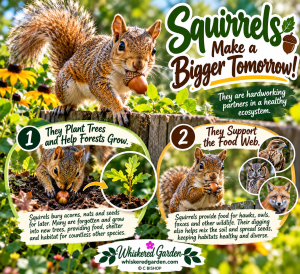
1. Squirrels Plant Trees and Help Forests Grow
One of the most valuable things squirrels do is plant trees, often without realizing it.
As fall approaches, squirrels collect acorns, walnuts, hickory nuts, and other seeds. Rather than eating everything immediately, many squirrels bury food in different locations to retrieve when resources become scarce.
This behavior is called “scatter-hoarding”.
Although squirrels have remarkable memories and use their sense of smell to locate buried food, they do not recover every nut they store. Some remain underground, where conditions may allow them to germinate and grow into new trees.
Think about what that means for the future.
A single forgotten acorn has the potential to become an oak tree that lives for generations. That tree may eventually provide nesting places for birds, food for insects, shelter for mammals, and leaves that enrich the soil.
Oak trees are especially valuable because they support an extraordinary variety of insects, including caterpillars that many birds depend upon to feed their young.
Squirrels also help move seeds away from parent trees. This can reduce competition for space and resources while allowing trees to establish themselves in new locations.
Not every buried seed will grow, and squirrels sometimes eat seeds that might otherwise germinate. Nevertheless, their seed-burying behavior makes them important contributors to forest regeneration.
The next time you see a squirrel digging in your yard, consider the possibility that you are watching a future tree being planted.
A small acorn buried today could become a home for wildlife tomorrow.
2. Squirrels Support the Food Web and Healthy Ecosystems
Every healthy wildlife habitat depends on relationships among plants, animals, insects, and the soil beneath our feet.
Squirrels are part of that interconnected system.
They are prey for animals such as hawks, owls, foxes, and other natural predators. Although we may not like thinking about one animal becoming food for another, these relationships are essential to functioning ecosystems.
Predators need reliable food sources to survive and raise their young. Squirrels help sustain those populations, just as plants, seeds, and nuts help sustain squirrels.
Their contribution does not stop there. When squirrels bury and retrieve food, they disturb small areas of soil. This activity can help mix surface material into the ground and create small spaces where seeds may settle. Squirrels also move nuts and seeds throughout their territories. Some are eaten, others are stored, and a portion may eventually grow into new vegetation. That vegetation supports insects, birds, and mammals, creating additional connections throughout the food web.
Healthy habitats are not built around a single species. They depend on many different animals performing different ecological roles.
Removing or discouraging wildlife simply because we find an animal inconvenient can overlook the contributions that species makes to the larger environment.
At Whiskered Garden, we believe every animal deserves to be understood before being judged.
Squirrels are not just living in the ecosystem. They are helping sustain it.
A Different Way to Look at Your Backyard
The next time a squirrel runs across your fence or buries an acorn beneath a tree, take a moment to appreciate what is happening. You may be witnessing the beginning of a new tree, a small contribution to soil activity, or an animal fulfilling its place in a much larger food web. A healthy habitat makes room for these natural relationships.
When we learn what wildlife contributes, we begin to understand why protecting even the smallest backyard neighbors matters.
Small actions in nature can create benefits that last for generations.
Whiskered Garden | whiskeredgarden.com
Creating habitat. Protecting wildlife. Inspiring compassion.