How Everyday Yards Can Become Lifelines
By Cindy Bishop, Whiskered Garden
Butterflies are more than floating color in a summer garden. They are pollinators, part of the food web, and beautiful reminders that even small changes in our yards can make a difference.
Across North America, many butterfly populations are struggling. Habitat loss, pesticide use, changing environmental conditions, and landscapes dominated by lawns have reduced the places where butterflies can feed, reproduce, and complete their life cycles.
The spaces they once depended on are disappearing.
Fortunately, we have the ability to give some of that habitat back.
Your yard can become part of the solution.
Why Butterflies Matter
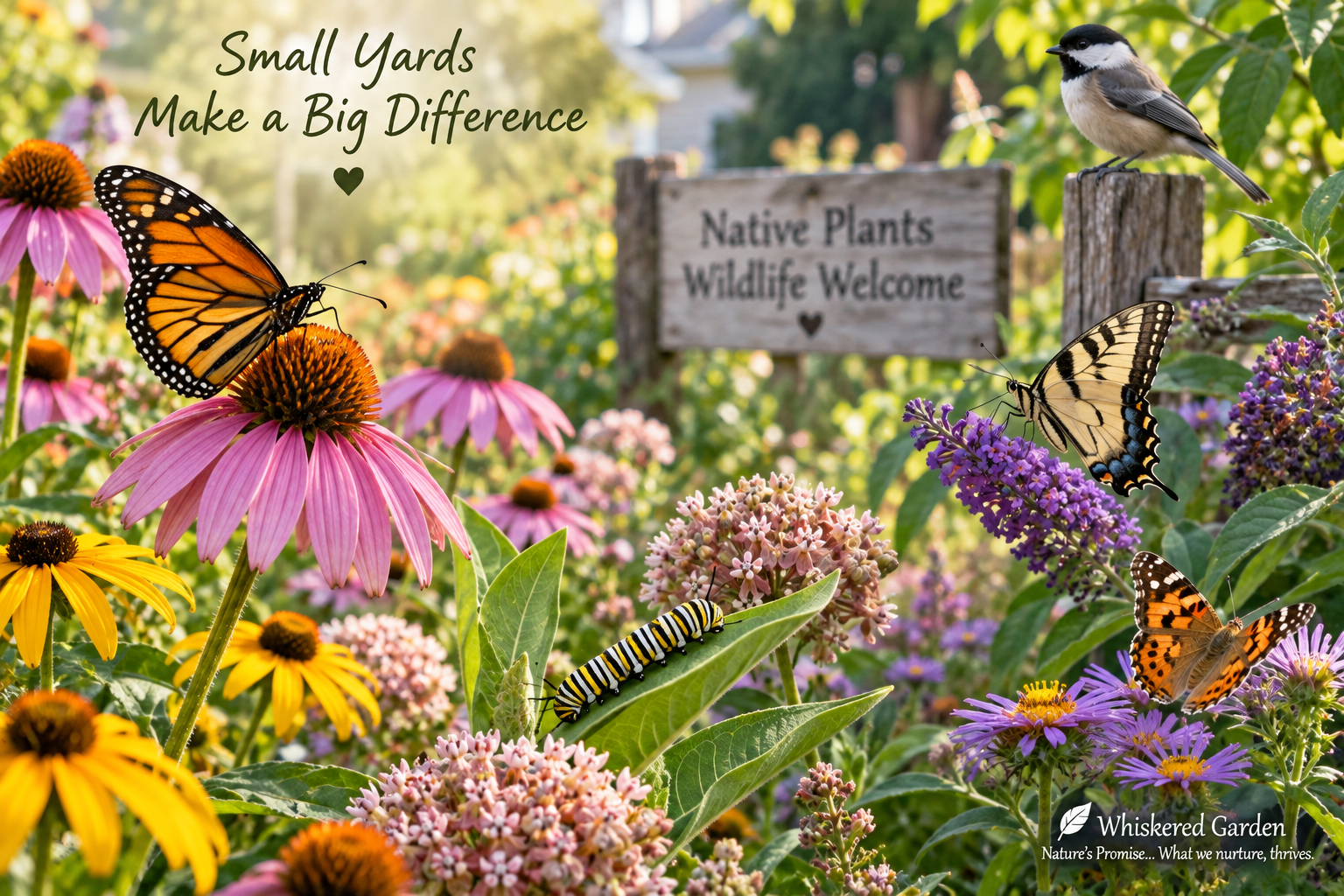
Butterflies contribute to pollination as they travel from flower to flower in search of nectar. They also play another important role in the food web.
Caterpillars are an essential food source for many birds, especially when birds are raising their young. Other animals also depend on butterflies and caterpillars as part of their natural diet.
Their presence can tell us something about the environment around us. A landscape filled with native plants, insects, birds, and other wildlife is very different from one where those living connections have disappeared.
Protecting butterflies is about much more than enjoying something beautiful in the garden.
It means protecting habitat that supports an entire community of life.
Butterflies Cannot Raise Families on Grass Alone
A perfectly manicured lawn may look attractive to people, but it offers very little to most butterflies.
Adults need flowers that provide nectar. Their caterpillars have different requirements and often depend on particular host plants for food.
Monarchs provide one of the best-known examples. Monarch caterpillars depend on milkweed. Adult monarchs can drink nectar from many flowers, but females need milkweed on which to lay their eggs because their caterpillars require it for food.
Without the right host plants, butterflies may visit a yard without being able to reproduce there.
That is an important difference.
A butterfly garden should not simply attract adults. It should help create the next generation.
Start With Host Plants
Host plants are the plants butterflies use to lay their eggs and feed their developing caterpillars.
Different butterfly species need different plants. Milkweed supports monarch caterpillars, while other butterfly species rely on completely different native plants. Variety matters!
Before choosing plants, learn which butterflies are native to your area and which host plants they use. Adding several appropriate species can turn an ordinary flower bed into a place where butterflies can complete their life cycle.
Do not be discouraged when caterpillars begin eating those plants. Chewed leaves can be a sign that your habitat is working.
Provide Nectar From Spring Through Fall
Adult butterflies need reliable sources of nectar throughout the growing season.
A garden filled with flowers for only a few weeks may look beautiful, but butterflies benefit from blooms that continue from spring through fall.
Choose plants with different flowering periods so that when one finishes blooming, another begins. Native plants are especially valuable because they have relationships with the insects and wildlife found in the same region.
Planting flowers in groups can also make them easier for pollinators to find.
You do not need an enormous garden. A sunny flower bed, a small section of converted lawn, or even containers on a patio can provide useful food.
Give Butterflies a Chemical-Free Place to Live
A butterfly habitat should be a safe place.
Insecticides can kill the insects we are trying to protect. Herbicides may remove plants they depend on for food and shelter. Some products marketed for routine garden use can also affect beneficial insects.
Before treating a yard, consider what else may be living there.
A caterpillar resting on a leaf may become tomorrow’s butterfly. An insect hidden among the flowers may be food for a nesting bird.
At Whiskered Garden, I choose to work with nature rather than trying to control every part of it.
A few imperfect leaves are a small price to pay for a living garden.
Remember Water and Minerals
Butterflies need more than flowers.
You may occasionally see several gathered on damp soil, mud, or another moist surface. This behavior is known as puddling. Butterflies can obtain moisture, salts, and minerals from these areas.
Creating a simple puddling area does not require much space. A shallow dish containing damp sand or soil can provide a place for butterflies to land safely.
Keep it moist rather than filling it with deep water. Small habitat features like this can make a garden more useful throughout a butterfly’s life.
Small Changes Can Have a Big Impact
You do not need acres of land to help butterflies.
A patio with containers can provide nectar. Part of a lawn can become a native flower bed. Milkweed can provide a place for monarchs to reproduce, while other host plants can support additional butterfly species.
Leaves left in appropriate areas can also provide habitat for insects and other small creatures. When spring arrives, delaying heavy cleanup gives overwintering life more time to emerge.
Instead of asking whether your property is large enough to matter, ask what part of it could become habitat.
Beauty With Purpose
One of the most remarkable things about butterflies is their transformation.
A tiny egg becomes a caterpillar. The caterpillar grows and eventually forms a chrysalis. In time, an adult butterfly emerges.
When we create a habitat, we may have the opportunity to witness that transformation in our own yards.
But there is something even more important happening.
A garden created for butterflies also supports other pollinators, insects, birds, and wildlife. What begins with one milkweed plant or one patch of native flowers can become part of a much larger living system.
Beauty becomes something more than decoration. It has a purpose.
Becoming a Butterfly Helper
Helping butterflies can begin with a few simple choices.
Plant native flowers and include host plants for species found in your area. Avoid pesticides whenever possible, provide a safe source of moisture, and allow parts of your property to remain a little more natural.
Then share what you learn and do with others.
One butterfly garden may seem small. Imagine what happens when an entire neighborhood begins creating them.
Every yard matters, and every effort adds another piece of habitat.
At Whiskered Garden, our mission is to inspire everyday people to turn ordinary spaces into thriving wildlife habitat.
Butterflies are not simply beautiful visitors passing through.
They are part of the living community around us, and they need places to survive.